
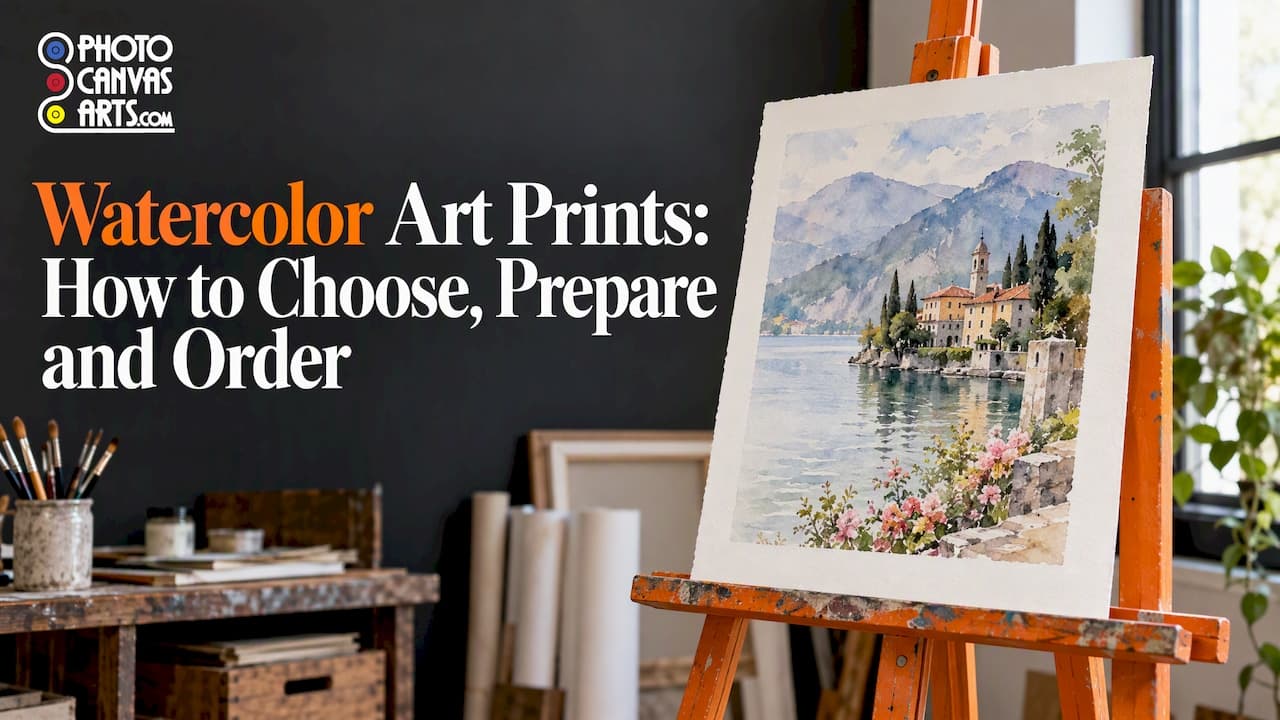
A watercolor art print is a reproduction of a watercolor image, printed on paper or canvas so you can hang the look of the original without paying for the original. A good one keeps the soft edges, the pooled pigment and the pale washes that make watercolor what it is. A bad one turns them into flat, muddy color. The difference comes down to three things you control: the file you start with, the surface you print on, and how you display the result.
This guide covers all three. It is for artists who want to sell or hang their own work, families turning a painted portrait or a child's artwork into wall decor, and anyone ordering a custom watercolor print as a gift.
TL;DR
- A print is a reproduction, not an original. That is fine for decor and gifts, but it should be described honestly if you sell it.
- Start with a clean scan or high-resolution file. For watercolors, scanning at 200 to 300 dpi is a common working range, depending on the size and detail of the original.
- Paper suits delicate washes and framed display. Canvas suits bolder, more saturated images and frameless hanging.
- Light is the main threat to a print's life. Keep it out of direct sun and use mats or glazing that protect the paper.
- You can upload your image to Photocanvas, preview it on canvas or paper, and order in the size you want.
Table of Contents
- What a watercolor art print actually is
- Paper or canvas: which surface suits a watercolor image
- How to prepare your watercolor file
- Custom watercolor prints from a photo
- Will it last? Durability and display
- Choosing size and finish for the room
- Who orders watercolor prints, and what they usually pick
- Our perspective
- Order your watercolor print with Photocanvas
- A simple checklist before you order
- FAQ
- Sources
What a watercolor art print actually is
The word "print" covers more than one thing, and the difference matters when you buy or sell.
The Smithsonian American Art Museum explains that traditional printing transfers ink from a prepared surface to paper, and that other techniques, including digital prints, exist alongside it. It also notes that reproductions of paintings are not original artworks. That is the category a watercolor art print normally falls into: a faithful copy of a painting, made by scanning or photographing it and printing the file.
There is a second meaning worth knowing. In traditional printmaking, an edition is the total number of impressions made from one image, and a single print may be numbered, such as 5/25. The Smithsonian says each impression in such an edition is considered an original print. A reproduction of your watercolor, even a beautiful one, is a different thing from that. If you sell reproductions, call them reproductions or open-edition prints. If you decide to limit a run and number it, say so plainly and keep to the number.

Original vs. print: how people tell them apart
Collectors often look at texture. The Foundation for Advancement in Conservation notes that an original watercolor generally has a rough surface when viewed at an angle, while a reproduction typically has a flat, even surface. The same source adds an important warning: sophisticated reproductions can imitate surface texture, and some have no visible dots and may even be embossed to mimic brush marks. So visual inspection is a hint, not proof.
For buyers of decor, this is good news. You do not need to worry about being fooled, because you know what you are buying. For artists, it means a high-quality print can carry a lot of the feel of the original, which is exactly what you want when a client asks for something close to the painting but at a price that fits a gift budget.
Paper or canvas: which surface suits a watercolor image
Watercolor was made for paper. Pigment sits in thin, translucent layers, and the white of the sheet does the work of light. When you print a watercolor, the surface changes how that translucence reads.
Art paper
Paper is the natural match for light, airy work: botanical studies, loose landscapes, portraits with soft edges, nursery art. Matte and fine art papers have a gentle tooth that keeps highlights from looking shiny, which helps the image feel like paint rather than a photograph. Paper also frames well behind glass with a mat, which gives a watercolor the gallery look people expect.
Photocanvas offers premium paper prints in matte and fine art paper, so you can choose the surface closest to the feel of your original.
Canvas
Canvas gives a watercolor a different personality. The weave adds texture of its own, and the image can look bolder on it, particularly when the original has strong color or heavy washes. Canvas needs no glass, which makes it practical for kids' rooms, offices and busy hallways where glare and breakage are concerns.
If you go with canvas, the edge style changes the look. A gallery wrap carries the image around a deeper frame, and a slim profile is lighter and more understated. Photocanvas offers both gallery-wrap and slim-profile canvas, plus rolled canvas if you plan to stretch or frame it yourself.
A quick comparison
| Question | Paper print | Canvas print |
|---|---|---|
| Best for | Delicate washes, pale palettes, detailed line work | Bold color, large statement pieces |
| Feel | Smooth to lightly textured, close to the original medium | Woven texture adds depth |
| Display | Usually framed with a mat and glazing | Hangs without glass |
| Glare | Depends on glazing | Low |
| Best rooms | Studies, bedrooms, dining rooms, galleries | Playrooms, offices, living rooms |
There is no wrong answer. Many artists order the same image both ways and let the room decide.
How to prepare your watercolor file
The print can only be as good as the file. Most disappointment with custom prints traces back to a low-quality source, not the printer.
Scanning or photographing the original
If your watercolor is a physical painting, scan it flat when you can. An Artists Network guide on scanning for posterity describes scanning watercolors at 200 or 300 dpi, depending on the original's size and detail. It also points out that TIFF is a lossless format, even though the author often uses JPEG. As a rule, keep a lossless master if you have one, and upload the highest-quality version you can.
A few habits make a big difference:
- Flatten the paper. Cockled paper throws shadows. Lightly press it under weights before scanning if it is stable enough to handle.
- Scan large work in sections. If the painting is bigger than your scanner bed, scan overlapping tiles and stitch them. Do not shrink the original to fit.
- Use even light if you photograph. Two lights at 45 degrees, with no glare on the surface, keep the washes from showing hot spots.
- Do not over-edit. A small levels adjustment is usually enough. Heavy sharpening makes soft edges look crunchy, which is the opposite of watercolor.
Resolution and print size
Resolution is how many pixels your image contains compared with the physical size you want. More pixels let you print larger without softness. As a practical approach, check your image's pixel dimensions and divide by the print size in inches. Around 200 to 300 pixels per inch is a comfortable target for work viewed up close, and large pieces seen from across a room can get by with less. Because watercolor is soft by nature, it tolerates moderate enlargement better than sharp photographs or fine line illustration, but a thumbnail saved from social media will not rescue itself.
When in doubt, upload the biggest original you have. The live preview in the Photocanvas customizer lets you see how your image sits at different sizes before you commit, so you can catch a size that looks too ambitious for the file.
Keeping color honest
Watercolor pigments often fall in ranges that screens and printers handle differently: delicate violets, clean turquoises, warm transparent yellows. A few tips help:
- Compare the print preview against the original under daylight, not just on your monitor.
- Keep your screen brightness at a moderate level when judging color, since a very bright display makes everything look paler once printed.
- Leave a little white margin in your scan if you want the paper edge to be part of the look, or crop tight if you want the image to fill the surface.
- Ask for guidance before ordering a large run if you have a color that matters, such as a brand shade or a portrait skin tone.
Custom watercolor prints from a photo
Not every custom watercolor print starts with a painting. Some people want a family photo, a pet or a wedding venue turned into a watercolor-style piece. That usually means one of two paths: hire an artist to paint it, then print the scan, or apply a watercolor effect to a digital photo and print that.
If you take the digital route, start from a sharp, well-lit photo with a clear subject. Effects work better on images with simple backgrounds, because busy ones turn into noise. Keep the processed file at full resolution, and save a copy of the original photo in case you want to print it as-is too. Our post on how to choose a matte or glossy finish is worth a look if you are deciding how much sheen a processed image can take. In most watercolor cases, a matte surface keeps the look closer to paper.
For a kid's room, the same idea applies to children's own paintings. Scan them, print them, and let the original go in a keepsake box. We wrote about this kind of display in our playroom wall art ideas, which cover how to build a gallery that changes as children grow.
Will it last? Durability and display
A print can look great on day one and fade quietly over years. What you do after it arrives matters nearly as much as what you ordered.
Ink and paper
Pigment-based inks are a common choice for long-lived prints. Epson, for example, says its UltraChrome HD pigment inks in the SureColor P800 improve print permanence and detail. That is a statement about one manufacturer's product, not a promise about every print, so when you buy from anyone, ask what inks and papers they use.
The Library of Congress suggests that buyers check that pigment-based inkjet prints are made on the manufacturer's appropriate matching paper and consult Wilhelm Imaging Research permanence ratings when they exist. Matching paper and ink matters because a mismatch can shorten a print's life.
Light is the real enemy
The same Library of Congress guidance says permanent display of paper-based art is not recommended, because light causes permanent, irreversible damage, and it suggests displaying a facsimile instead. That is a useful way to think about a watercolor print: it is a facsimile by design. If the original is precious, keep it dark and hang the print.
For inkjet prints, the Library's care leaflet recommends light levels of 30 to 100 lux, limited display time, and UV no higher than 75 microwatts per lumen. Those are museum conditions, and most homes will not meet them. Still, the direction is clear:
- Avoid direct sunlight, including a window that gets afternoon sun.
- Choose UV-filtering glazing for framed paper prints in bright rooms.
- Rotate prints now and then if you want a favorite to last.
- Store spare prints dark, at room temperature, with relative humidity of 30 to 50 percent, as the Library of Congress advises.
Mats and frames
A mat does more than look good. The Library of Congress describes a window mat as a structure that gives gentle, steady physical support and is chemically inert. In plain terms, it keeps the paper from touching the glass, where moisture can cause sticking, and it keeps acidic materials away from the print. If your frame shop offers acid-free or conservation mats, choose them for anything you care about.
Canvas takes a different route. With no glass, it relies on a surface that handles room conditions well and on you keeping it away from direct sun, heat sources and humid bathrooms.
Choosing size and finish for the room
Size is where most people either undershoot or overshoot. A few working rules:
- Over a sofa or bed: aim for a piece, or a group, that spans roughly two thirds of the furniture's width.
- Desk or shelf: small and medium sizes work, and paper is easy to frame at a modest scale.
- Gift: go for a size that fits standard frames, so the recipient can swap it in without extra cost.
- Office or reception: one larger canvas has more impact than several tiny pieces and needs no glass.
Finish decides how the light plays across the image. Matte softens reflections and suits watercolor's quiet tones. Glossy intensifies color and suits saturated work, but it shows fingerprints and glare. Our matte versus glossy guide walks through the trade-offs in more detail.
Who orders watercolor prints, and what they usually pick
Artists use prints to sell more than one copy of a single painting. They often order paper for storefronts and shows, and canvas for larger commissions or for display in their own studio. If you plan to resell, Photocanvas can prepare orders for resale or tax exemption for businesses and artists.
Families often turn a painted portrait, a child's first watercolor or a house sketch into something for a hallway or grandparents' wall. Paper with a mat is a classic choice; canvas works well for rooms where kids play.
Businesses choose canvas for offices, clinics and reception areas because it hangs cleanly and avoids glare. Watercolor's soft palette tends to calm a waiting room.
Gift buyers like a custom piece because it feels personal. A watercolor of a first home, a pet or a wedding place is rarely duplicated.
Our perspective
We see the same pattern again and again with watercolor files. The people who are happiest with their prints are rarely the ones who spent the most. They are the ones who started with a clean scan, chose a surface that matched the mood of the painting, and looked at the preview before ordering.

Watercolor is a medium of restraint. It does not need heavy sharpening, loud saturation or a glossy shine. When a print looks wrong, it is usually because someone tried to push it: the file was shrunk and enlarged, the contrast was boosted, or the finish fought the paint. Our advice is to let the painting stay quiet. Choose matte or fine art paper for delicate work, choose canvas when you want presence, and match the size to what your file can truly support.
We also think printing should be easy to try. That is why we built a live preview, so you can see an image on canvas or paper, at your chosen size and edge style, before you pay. If something looks off, you will see it there rather than on your wall.
— Diego
Order your watercolor print with Photocanvas
If you are ready to turn a painting or photo into a print, Photocanvas lets you upload your image, pick canvas or paper, choose a size, finish and edge style, and check it in the live preview. Canvas options include gallery-wrap and slim-profile, with rolled canvas available too. Paper options include matte and fine art paper. Orders are packed with care and shipped securely, and our customer care team stands behind a satisfaction guarantee. You can start from the Canvas Prints and Paper Prints page.
A simple checklist before you order
- Confirm your file is the largest, cleanest version you have.
- Decide paper or canvas based on where it will hang and how much texture you want.
- Pick a finish that suits the palette: matte for soft washes, glossier for saturated color.
- Check the preview at your chosen size, including the edges.
- Plan the display: mat and UV-filtering glazing for paper, a wall away from direct sun for either.
- Keep your original file safe, so you can reorder in another size later.
FAQ
Is a watercolor art print worth it compared with an original?
It depends on what you want. An original is a one-of-a-kind object, while a print is a reproduction that lets you enjoy the image at a lower cost and in more places. For decor, gifts and family keepsakes, a well-made print is usually the practical choice.
What file do I need for a custom watercolor print?
Upload the highest-quality image you have, ideally a clean scan or a sharp photograph of the painting. Scanning at 200 to 300 dpi is a common range for watercolors, depending on the size and detail of the original. A small, heavily compressed image can look soft at larger sizes, so check the live preview before ordering.
Should I print a watercolor on paper or canvas?
Paper keeps the look closest to the original medium and suits delicate washes, especially when framed with a mat. Canvas adds texture and presence, hangs without glass, and works well in busy rooms. Many people choose paper for pale, detailed work and canvas for bolder pieces.
How do I stop a watercolor print from fading?
Keep it out of direct sunlight, use UV-filtering glazing on framed paper prints, and rotate display when you can. The Library of Congress also advises storing spare paper-based prints in the dark, at room temperature and 30 to 50 percent relative humidity. No print is fade-proof, but light control makes the biggest difference.
Can I sell prints of my own watercolor paintings?
Yes, many artists sell reproductions of their own work. Describe them as reproductions or open-edition prints, and only call a print limited edition if you really cap and number the run. If you buy for resale, Photocanvas can prepare orders for resale or tax exemption for businesses and artists.
Sources
- Want to Research Prints or Find Posters? Smithsonian American Art Museum
- Authentication and Evaluation of Paintings, Foundation for Advancement in Conservation
- Scanning for Posterity, Artists Network
- Epson SureColor P800 Designer Edition Printer
- Paper FAQ, Library of Congress Preservation
- Information Leaflet on the Care, Handling, and Storage of Photographs, Library of Congress
- Preservation Matting, Library of Congress