
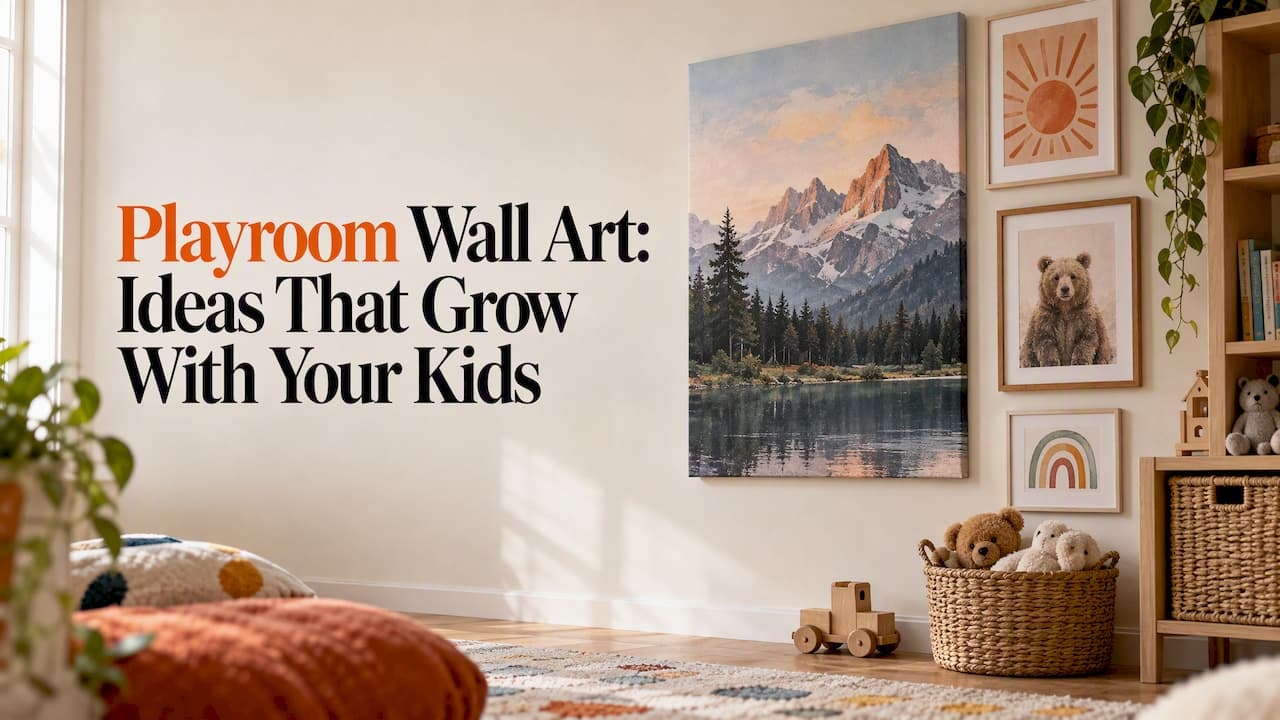
The best playroom wall art does three jobs at once. It gives kids something to look at and talk about, it stays out of reach of climbing hands, and it still looks good to the adults who share the room. The easiest way to get there is to pick a calm, flexible base, then add a few pieces with real personality: your child's own drawings, family photos, favorite animals or maps. Those are the pieces that are easy to swap as interests change.
Below you will find what to put on the walls, how to mix canvas and framed prints without the wall looking chaotic, where to hang things, and what to check for safety.
TL;DR
- Choose a neutral or earthy base and let art carry the color. Designers say this lets a room shift from nursery to reading nook to creative studio without a full redo.
- Mix canvas and framed paper prints by repeating one color, one theme or one spacing rule across all of them.
- Hang art at a child's eye level in reading and play zones, and keep heavy frames off the area above furniture kids climb.
- Anchor dressers and bookcases to the wall. The CPSC urges this for every home where children live or visit.
- Printing your kids' artwork and family photos on canvas or art paper gives you playroom art no store can match.
Table of Contents
- What to put on the walls of a playroom
- Colors and styles that still work in three years
- Mixing canvas and framed prints on one wall
- Where to hang it: height, zones and kid-level displays
- Safety checks before you hang anything
- Our perspective: make the wall a family project
- Turn your own images into playroom art
- A starter plan: three walls, three budgets of effort
- Planning for teens and tweens
- FAQ
- Sources
What to put on the walls of a playroom
Start with how the room is used, not with a theme. A playroom usually has a few zones: a building or craft area, a reading corner, a place for dress-up or screens, and storage. Each zone can carry a different kind of art.
- Craft and building zone: bold, graphic pieces and a display spot for kids' own work. Energy is welcome here.
- Reading corner: calmer art, low on the wall, that invites a look from a beanbag or floor cushion.
- Lounge or TV area: softer prints that reduce visual noise, since screens already supply plenty of stimulation.
- Entry wall: your gallery wall, where family photos and larger statement pieces live.
If you are stuck, these categories work in almost any playroom:
- Animals and nature. Jungle animals, ocean scenes, birds and botanical prints. Nature-inspired art is a strong current trend, and designers describe a preference for illustrative, timeless styles over overtly juvenile characters.
- Maps, letters and numbers. A world map or an illustrated alphabet teaches without feeling like a classroom.
- Space, dinosaurs, vehicles. Pick one and use it as a focal point, not as a wall-to-wall theme.
- Abstract color. Shapes and brushstroke-style prints give kids a vocabulary for color without telling them what to see.
- Your own images. Family photos, a favorite vacation shot, a child's drawing enlarged to wall size.
Art that teaches without a lesson plan
Educational decor is moving toward what some designers call passive learning: maps, alphabets or science-themed pieces woven into the decor so curiosity is nurtured without making the space feel like a school. The same source recommends reading nooks with low, accessible wall art to encourage engagement at the child's eye level.
A practical version: a vintage-style world map above the reading corner, a single anatomical-style animal print nearby, and a row of small prints at kid height that you rotate every season.
Colors and styles that still work in three years
Kids' rooms are leaning toward softer palettes. One 2026 trend roundup points to terracotta, sage green and warm ochre as the tones designers are reaching for, along with nature-inspired murals and illustrations that age well.
That does not mean a playroom should be beige. It means the permanent parts, such as paint, shelving and rugs, can be quiet, while art delivers the brights. When your child outgrows dinosaurs, you swap three prints instead of repainting.
A few rules of thumb we use when helping people plan a wall:
- Pick two or three accent colors and repeat them across at least three pieces.
- Keep one piece in the room "grown-up": a large landscape, an abstract or a black-and-white family photo. It anchors the wall and keeps the room from feeling like a toy aisle.
- Leave blank space. A wall filled edge to edge reads as noise. Empty wall around a group of art gives the eye a place to rest.
One more design note: designers Tenlie Mourning and Maggie Richmond stress that playroom walls should be stimulating for the child yet grounded enough for adults. That balance is a good test for every piece you hang: would a kid love it, and could a parent live with it?
Mixing canvas and framed prints on one wall
A mixed media gallery wall is the most flexible playroom display. Canvas brings texture and a soft, frameless edge. Framed paper prints bring crisp detail and a finished look. Together they make a wall that feels collected, not copied from a catalog.
The risk is a wall that looks random. These steps keep it intentional.
Give the wall one unifying rule
Pick one of these and stick to it:
- Color: every piece contains the same accent, such as ochre or sage.
- Subject: all animals, all maps, or all family photos.
- Frame finish: all black, all natural wood, or all white for the framed pieces, with canvas providing the contrast.
- Spacing: the same gap, around 2 to 3 inches, between every piece.
You can break one of those rules, but not all of them at once.
Let canvas be the anchor
A large canvas makes a natural focal point because it has no frame and a lot of presence. Surround it with smaller framed paper prints that echo its colors. Because canvas is light and frameless, it also suits the lower, more casual part of the wall where kids can see it up close.
Use paper for detail, canvas for mood
Fine detail, such as map labels, illustrated lettering or a pencil drawing with delicate lines, usually looks best on art paper under glass or acrylic in a frame. Photos with rich color, big landscapes and bold digital art tend to look good on canvas, where the texture softens the image. If you are unsure, order the same image on both and compare it in the room.

Vary size and orientation
Mix horizontal and vertical pieces, and combine one large item, two medium and several small ones. Lay everything on the floor first, or cut paper templates and tape them to the wall. Move them around until the weight feels balanced, then hang.
A simple layout for a 6-foot wall
- Hang one large canvas slightly off center.
- Add two medium framed paper prints on the long side, aligned along the top or bottom edge.
- Fill the gaps with three or four small prints at lower height, in the reading or play zone.
- Step back, and remove one piece if the wall feels crowded.
Where to hang it: height, zones and kid-level displays
Adult gallery rules put art around eye level for a standing adult. A playroom has two audiences, so think in layers:
- Upper layer: larger, more permanent pieces at adult eye level or a little above, for the view from the doorway.
- Kid layer: lower prints and a rotating display strip where children can look, point and talk about the art.
In reading corners, hang art low, since kids will be sitting. Check by sitting on the floor yourself and looking at the wall. Whatever sits at your eye level from there is the right height for the nook.
For kids' own artwork, a simple picture ledge or a cord with clips gives a rotating display. Once a drawing becomes a favorite, scan or photograph it, then print it on canvas or art paper to make it permanent. Children tend to light up when they see their own work treated like real art.

Safety checks before you hang anything
A playroom is not a gallery, so safety comes first. These checks take little time.
- Anchor the furniture. The CPSC says to anchor TVs and furniture, including bookcases and dressers, securely to the wall. Nearly 80% of tip-over fatalities involving furniture, TVs and appliances, as reported in the CPSC's 2019 figures, involved children 5 and younger.
- Do not tempt climbing. Avoid hanging art, especially heavy framed pieces, above dressers or bookcases that kids climb. If a child might reach for it, it is too accessible.
- Choose lighter pieces for low spots. Canvas has no glass, which makes it a sensible choice for the lower part of a wall. For framed paper prints in reach, ask for acrylic glazing instead of glass.
- Use proper hardware. Match anchors to your wall type and the piece's weight. Check hooks and wires a couple of times a year, because a playroom gets bumped.
- Watch for magnets and small parts. The CPSC's child safety guidance warns that strong magnets can cause serious harm if swallowed. If you use magnetic display strips or magnetic frames, keep small magnets well away from young children.
If you are unsure whether a wall, a piece or a piece of furniture is safe for a toddler, check the CPSC's guidance, and ask a licensed contractor to help with heavy installations.
Our perspective: make the wall a family project
At Photocanvas, we spend our days turning digital art, photos and personal memories into prints, and we see the same pattern in playrooms. The walls families love most are not the ones filled with store-bought characters. They are the ones with something personal on them.
We suggest a three-part approach. First, one hero piece: a large canvas that sets the color and mood. Second, a handful of supporting prints on art paper, framed to your taste. Third, a flexible zone at kid height that you refresh as interests shift.
We also encourage people to print what is already in their phone. A beach photo, a grandparent portrait, a drawing your child made at the kitchen table: all of these are better playroom art than a generic poster, and they cost nothing to create. Our canvas is handcrafted and our paper prints are made on premium art paper, so the finished piece looks like something you chose, not something you settled for.
One piece of advice we repeat: do not buy the whole wall at once. Hang the hero piece, live with it for a month, then add. Playrooms evolve, and so should the wall.
— Diego
Turn your own images into playroom art
If you want art that is personal, you can upload your own image to Photocanvas and see it before you order. Our live preview lets you check the crop, size and finish before checkout.
Here is how the options map to a playroom:
| Option | Good for | Why it works in a playroom |
|---|---|---|
| Gallery-wrap canvas | Hero piece, statement photo | The image wraps around the edges, so it looks finished with no frame |
| Slim-profile canvas | Tight spaces, gallery wall mixes | A lower profile that sits close to the wall beside framed pieces |
| Rolled canvas | Custom framing, large pieces, easy shipping | Ships rolled, so you can stretch or frame it locally |
| Fine art paper | Detailed illustrations, maps, drawings | Holds fine line work, ideal for framing |
| Matte paper | Pieces under glass | Reduces glare in bright rooms |
We offer Canvas Prints and Paper Prints in a range of sizes and finishes, shipped with careful packaging. If you want to compare how one image looks on canvas versus paper, start with your favorite photo or drawing and preview both.
Artists and small businesses can also use us for finished prints of their work, with resale or tax-exempt preparation available for business orders.
A starter plan: three walls, three budgets of effort
The quick refresh (one afternoon)
Pick one wall. Hang one large canvas and two small framed paper prints. Choose a single accent color from the canvas and repeat it in the frames or a rug.
The reading nook (one weekend)
Create a low display at child height: three or four small prints, a picture ledge and a basket of books. Add an illustrated map or alphabet above. Keep the colors soft, so the nook feels calm compared with the rest of the room.
The family gallery wall (a few weekends)
Plan a mixed canvas and framed arrangement on the biggest wall. Include family photos, kids' artwork scanned and printed, and two or three favorite illustrations. Use paper templates, and keep the spacing consistent. Add pieces over time as the child's interests change.
Planning for teens and tweens
Playrooms do not stay playrooms. Architectural Digest's 2026 piece on designing for kids notes that social media has replaced posters as the main visual interest for many tweens, so spaces need to balance calm, screen-free zones with interactive ones that can adapt as interests change.
For your wall, that means choosing pieces that can graduate. An abstract, a landscape or a black-and-white photograph will be as at home in a teen lounge as in a toddler's playroom. Save the very juvenile pieces for the easy-to-swap kid layer.
FAQ
What are the best wall art ideas for a playroom?
Start with one large hero piece, such as a canvas of an animal, map or favorite family photo. Add smaller prints in two or three repeated colors, and keep a low zone for kids' artwork. This keeps the room lively but easy to update.
Can I mix canvas and framed prints in the same room?
Yes, and it often looks better than all one type. Give the wall a unifying rule, such as one repeated color or consistent spacing, and use a large canvas as the focal point with smaller framed paper prints around it. Lay everything out on the floor before you hang.
How high should I hang art in a playroom?
Use two layers. Hang larger, permanent pieces at adult eye level or slightly higher, and place smaller prints low in reading and play zones. Sit on the floor to check that the low art is comfortable to see.
Is it safe to hang art in a kids' playroom?
It is, with a few precautions. Anchor dressers and bookcases to the wall, avoid hanging heavy frames above furniture kids climb, and use proper hardware for your wall type. Keep small magnets away from young children, per the CPSC's guidance.
Can I print my child's artwork for the playroom?
Yes. Scan or photograph the drawing in even light, upload the file and preview it at the size you want. Canvas gives it a soft, finished look, while art paper suits detailed line work and framing.
Sources
- The Nursery and Kids' Room Trends Designers Are Backing in 2026, Nestig
- Kids Room Design Trends in 2026 for Stylish Growing Spaces, HomeLane
- The New Rules of Designing for Kids, Architectural Digest
- CPSC Anchor It! Campaign Marks 10 Years, CPSC.gov
- Latest Anchor It! Statistics, CPSC.gov
- Child Safety, CPSC.gov